
Better than a historical teen soap opera, but only in terms of performances and visual design
“Many times you have said I cannot do what I have done.” – Mary Stuart, Queen of Scots
Overview – SPOILERS beyond this point
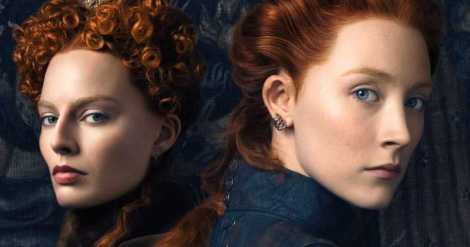
The new historical film, Mary Queen of Scots, following the life of Mary Stuart as she returns to Scotland, is out in theaters and, while it is beautiful to behold in terms of set and costume, it leaves something to be desired in every other area. The problem with that is that we already knew three things: Scotland and England are beautiful countries, Alexandra Byrne is a fantastic costume designer, and Saoirse Ronan and Margot Robbie are incredible actresses. I didn’t need a movie that only proved those three things.
The film itself is breathtaking. The sets are clearly authentically filmed in Europe and the costumes are stunning. For a more in depth conversational look into the costume, makeup and hair design of Mary Queen of Scots, listen to the podcast above where Professor Julie Leavitt, Costume Designer and Professor at Fairfield University, and I discuss the highlights and lowlights of the film, in regards to mis-en-scene, from her experienced point of view.
On first glance, the film presents a very clear cut view of the life of Mary Stuart. However, with a movie covering 25 years of life, it would be impossible for me to recount every single event that happened within the movie’s just over two hour run time. While there were important events covered, such as the birth of Mary’s son and heir, James, her multiple marriages, and eventually, spoiler alert, her beheading, 25 years was clearly too much for this movie to handle. The film plops us into 1561, and from then on takes great pleasure in jumping from year to year, only informing the audience of the passing of time based on hairstyles and the apparent age of Mary’s son James. Other than that, you’re pretty much entirely lost in terms of where you are on the 25 year timeline.
The first big issue this movie had was in the timeline and therefore the conflicts. The movie peaked several times, essentially making it three different films all in one. There was the plot line of correspondence between Mary and her cousin Elizabeth, Queen of England. While there was true historical proof that the two did write to each other in real life, much of the relationship between the two women in the film is fabricated, as neither felt a “sisterly” bond with the other, and the two never met in real life. The most realistic aspect was the fact that both in the film and in real life, both queens held the other in high regard as they recognized that strong female leadership is a rare commodity and therefore must be respected and acknowledged with authority, by authority.
The second plot line, and easily the most distracting, was that of the drama between Mary and the several men she married, and Elizabeth’s lack of marriage. The movie begins upon Mary’s return to Scotland after her first husband, the King of France, dies. Mary almost immediately marries her second husband, Lord Darnley, whom everyone advises her against marrying, snubbing Elizabeth in the process, and which proves to be not only a rash decision, but an incredibly poor decision as well. The drama that results from this feels unrealistic, disingenuous and soap opera-esc. While it may have been a poor choice in reality, there is no way it led to the kind of drama depicted of murder, a scene which is essentially rape, and tons of emotional and physical abuse.
The third plot, finally, gets to the political and religious turmoil rocking Europe at the time. This is what the main plot should have been, instead of focusing on fake relationships between the two most powerful women of the era and their love lives. Realistically, I’m not entirely sure this film can be called nonfiction. Yes, these are the names of real people, but that’s about where the similarities stop. A much more interesting film would have incorporated a more in depth look at Mary’s relationship with her court, her traitorous brother and John Knox, a religious leader consumed with ousting her from the throne.
As Professor Leavitt says above, John Knox was Mary’s real life foil, a Protestant leader who helped lead the rebellion against Mary simply because she was a woman and a Catholic. Leavitt remarks on the fact that Knox was portrayed as her foil through his clothing especially, which is why it’s a pity he is on screen for maybe a total of 20 minutes. He is shown in scenes briefly and far between, wasting David Tennent’s talent as an actor, and the character’s role in Mary’s eventual downfall. The film would have been much truer to reality and probably a lot more educational and interesting had it focused on the chaos erupting from having a Catholic and female ruler.
In fact, if religion had been mentioned more at all, this would have been all around a better film. I’m usually not one to complain about a lack of religious persecution, but religion played a huge role in the conflict between Mary and her country in reality. European people did not like her because she was a Catholic in a Protestant majority country. This was glossed over, at best, and if you don’t know anything about the history of the time or why there was conflict to begin with, good luck catching up because the movie never really explains it, it just hopes you understand that during this time Catholics and Protestants hated each other.
Off of that, the movie had more than one rising action, climax, and resolution. All of these conflicts came back more than once, but each also seemed to resolve more than once, as well. There was political turmoil, people fought in dark rooms and stormed around angry, there was a high stakes rebellion and a small war was waged on Scottish soil, Mary’s army won, and that seemed to be the end of it. That could have been an entire movie in and of itself, but instead it was a thread woven loosely into a larger web. The same issue occurred between the two Queens – Elizabeth sent Mary a suitor, Mary refused, chose a new man, married him, realized it was a mistake, stayed with him anyway, had a beautiful new baby, and made Elizabeth the godmother as a sign of peace and good faith. That in and of itself could have been an entire in depth movie. Instead, it, too, was shoved into a larger pool of information. I found myself frequently checking my phone asking myself, “Is it over? Was that the end? That seems like a good place to end but I’m not seeing any credits.”
All this being said, the movie is redeemed in a lot of ways due to the absolutely phenomenal performances delivered by the two leading ladies, and most of the supporting cast. Saoirse Ronan, playing Mary Stuart, delivers some incredibly powerful lines, truly embodying a Queen who is young and impulsive, never backing down, and whose strong will and pride are eventually her undoing. Above, Professor Leavitt and I have a good laugh about the lack of realism in the meeting between the two Queens, but we both mention that we appreciate the exchange between the Queens, and most of this is due to the acting. There is a fierce look in Ronan’s eyes as she tells Elizabeth that she is rightfully Queen, even as she has lost absolutely everything. Watching Ronan deliver a performance as she did in this movie reminds me why not everyone can just be an actor – it takes a very specific kind of fire that not everyone can conjure.
Despite the movie’s misleading title, Elizabeth is in most of the movie, with her relationship to Mary taking center stage for a good deal of the film. You would never know Margot Robbie wasn’t playing a titular character. Meaning, she played the role with such an air that I sat through the entire film thinking Robbie deserved to have her character’s name in the title somewhere. While the movie might focus more on Mary, it is Elizabeth that truly undergoes the most change throughout the film. Elizabeth is portrayed as the more strategic leader, thinking through every decision, always doing what she felt was the smartest choice for her country, even at a great personal cost. At the beginning of the film, Elizabeth is a woman being controlled, and by the end she is a fearsome creature to behold. Margot Robbie does a remarkable job portraying that slow burning change.
In order to truly enjoy this movie, one has to go into the movie expecting a very one sided view of the story. The movie is clearly intended to make a hero out of the prideful Mary, and villainize anyone that wouldn’t help her, including Elizabeth, one of the strongest women in history. This seems unfair to both parties as it doesn’t give either women the respect and incredible legacy both deserve for their respective contributions of society. To fully enjoy this movie, one has to understand that you’re not getting a documentary – actually far, far, far from it – and you have to be okay with that.
Everything the movie got right – HIGHLIGHTS
- Set design for using the pure beauty of Europe
- Costume design – not for accuracy, necessarily, but for the way it looked to our modern eyes
- The performances by all actors – not just Ronan and Robbie – but by everyone including supporting cast and ensemble roles
Everything the movie got wrong – LOWLIGHTS
- Tried to cover too many years
- 25 years
- Tried to cover too many conflicts
- Political trouble
- Love affairs (gone wrong)
- The relationship between the two Queens
- Overdramatized absolutely everything in both Queens’ lives from their relationships to their relationship with each other
Rating
🙊🙊🙊 3/5 SPEAKS!
 Cinema Speak
Leave a comment